A new Commission, new priorities: Europe’s global competitiveness
The year 2024 marked a pivotal moment globally, with numerous elections in Europe and beyond shaping the political landscape. Among these were the elections for new European Commission and Parliament Presidents, the College of Commissioners, and the European Parliament. Geopolitical tensions and developments heavily affected the outcomes and restructured the political landscape. It is The Guild’s mission to inform the new European officials about the importance of research, innovation and education in Europe and across the globe.
A changing context: security, the Single Market, and competitiveness
Towards the end of her first mandate, Commission President von der Leyen commissioned three landmark reports to consider the priorities, needs, and possibilities for the EU in rapidly shifting contexts. In the first of these, ‘Much more than a Market’, former Italian Prime Minister Enrico Letta argued that the EU needed to fully implement the Single Market by removing remaining barriers. For R&I, and education, he called for the fifth freedom – of research, innovation and education – to be realised, in order to catalyse R&D in Europe. Secondly, former Finnish President Sauli Niinistö called in his report ‘Safer Together’ for the better preparedness of the EU against military attacks, as well as other cross-border shocks and crises (including natural hazards or new pandemics). While these reports were critical in informing – and guiding – the policy debate in Brussels, the most seminal text in shaping the priorities of the emerging second von der Leyen Commisson was the third report by Mario Draghi, ‘The Future of European Competitiveness’. It argued that Europe had fallen behind its major global competitors, notably the US and China, not only in innovation but also in research, as well as skills. Europe was increasingly lagging behind in R&I in high, complex technologies, with Europe remaining stuck in the technologies and industries of the middle of the 20th century. Draghi called not only for a prioritisation of R&I (including through a significant increase in spending on both), but also for a transformed prioritisation of spending, focusing it on fewer, more effective instruments, including the European Research Council, and a reformed European Innovation Council.
These analyses, and especially the Draghi report, informed The Guild’s debates and reflections throughout the year, beginning with our Vice-Presidents, who discussed the report less than a week after its publication at their meeting in Tartu. But The Guild did not just discuss these reports internally – we also helped shape a wider public debate on the reports’ findings and conclusions, and how these matched up with the capacity and needs of our universities in research, innovation and education. In a dozen opinion pieces, published mainly in Times Higher Education and Research Professional, but also in widely followed and extensive social media discussions led by The Guild office staff, The Guild contributed to a wider debate about the future of European R&I, and its capacity to contribute to Europe’s future. At issue in our internal as well as external discussions was exactly how the aspirations of the Draghi report, and that of others, could be realised in practice.
Meetings with EVP Roxana Mînzatu and Commissioner Ekaterina Zaharieva
Earlier this year The Guild had the pleasure of engaging in a productive first meeting with Roxana Mînzatu, the newly appointed EVP for Social Rights and Skills, Quality Jobs and Preparedness, and members of her cabinet. This meeting took place only days after she took office, and The Guild’s representatives, including Berit Eika (Pro-Rector, Aarhus University), Bálint Markó (Vice-Rector, Babeș Bolyai University) and Jo Angouri (Deputy Pro-Vice-Chancellor, University of Warwick), urged a new spirit of collaboration between governments, the European Commission, and the sector, to unleash all the potential of higher education institutions to enhance collaboration and pedagogical innovation.
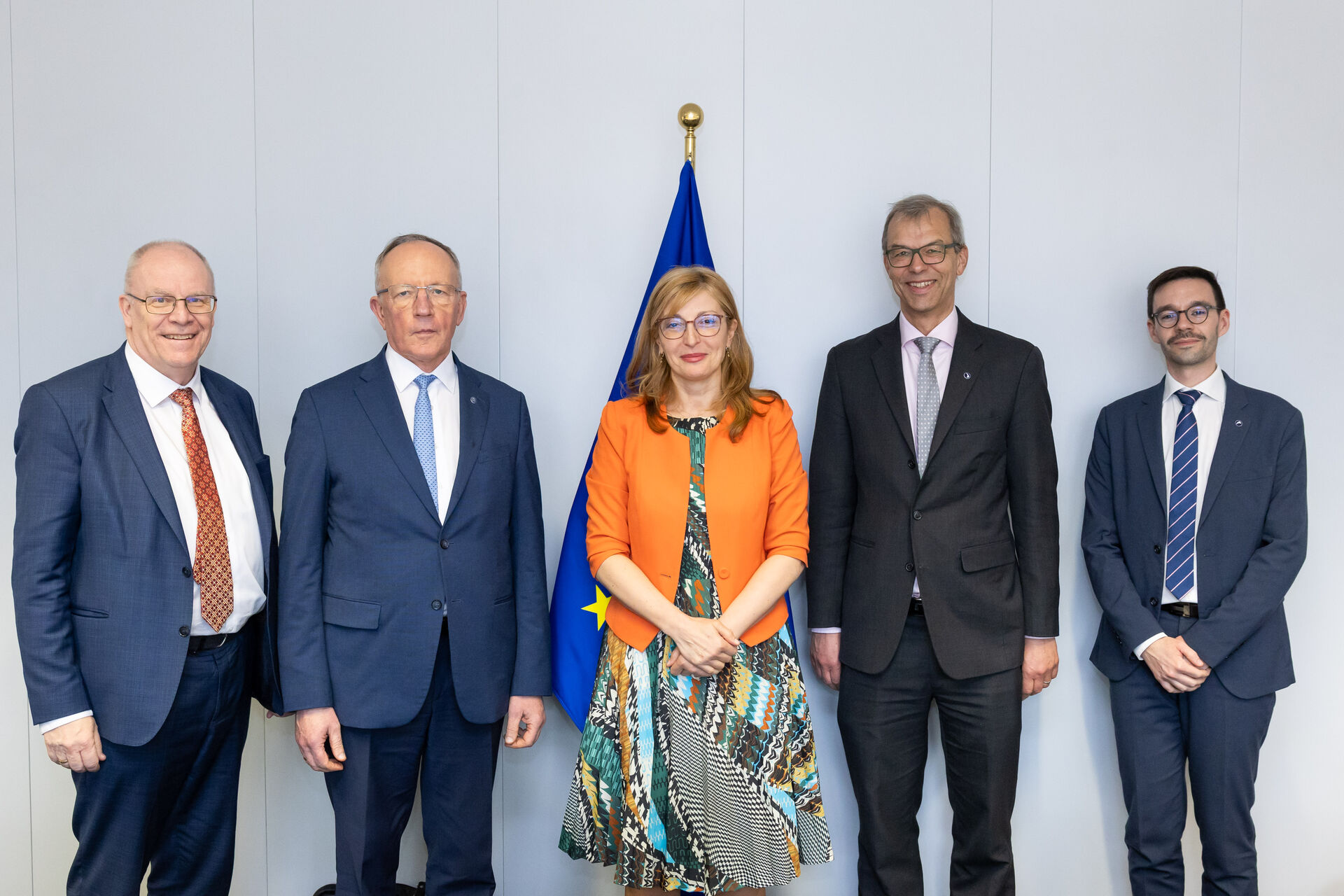
In March 2025, Anders Hagfeldt (Chair and Uppsala University Vice-Chancellor), Toomas Asser (Vice-Chair and University of Tartu Rector), Secretary-General Jan Palmowski and Head of R&I Policy Julien Chicot met Commissioner Ekaterina Zaharieva and her cabinet member Alexandra Hild. They discussed the future of the framework programme in the next MFF and the Commissioner’s vision for advancing the development of the ERA. During this exchange, The Guild delegation also urged the Commissioner to defend EU investment in international research collaboration as part of the EU Global Gateway initiative in the next MFF.
Other articles
- Advocating for a standalone Framework Programme for R&I
- Empowering higher education in the EU
- Africa-Europe Clusters of Research Excellence
- A renewed impetus for the European Research Area
- At the forefront of digital transformation
- Universities and the Green Deal objectives
- Transforming health research in Europe
- Interviews with The Guild interns